

Above Ošlje lies an unusual early medieval church ruin. Its plan is tangible, but its history is not fully understood. A cultural portrait of what stones tell us – and what is only added to the story later.
A church arranged around its centre
The Rotonda at the Bijela lokva site above Ošlje is one of southern Dalmatia’s unusual church buildings. Rather than a long nave, eight rounded apses surround a circular core. In his 2012 study, Pavuša Vežić describes it in the context of Dalmatian round churches.
The author dates the building to the 10th century. This art-historical classification is not a foundation date documented to the exact day. He also explicitly considers its identification with a church of St Peter mentioned in a later document to be uncertain.
Additions turn a plan into a history
Vežić describes a porch added later on the west side. Traces of stairs suggest a two-storey structure; he treats a possible bell tower as an interpretation. The vaults have not survived. For precisely that reason, later drawings or vivid illustrations must not be confused with the building actually preserved.
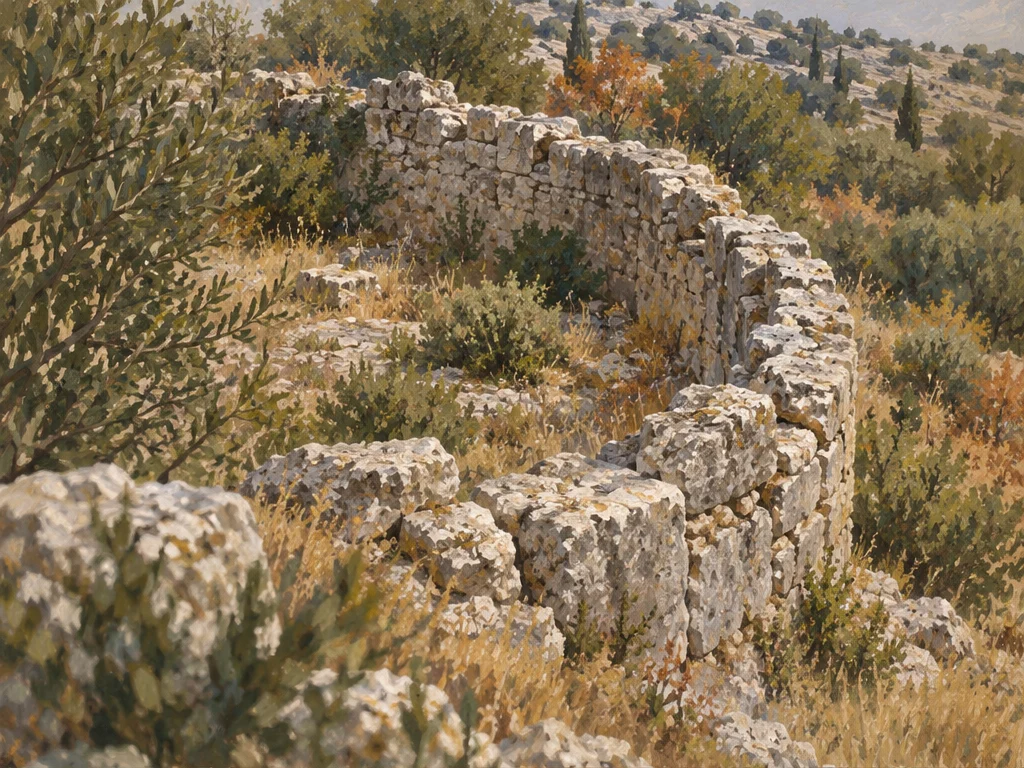
This is a useful distinction when reading a ruin: surviving masonry, inferred building phases and possible reconstructions do not have the same evidential value. Our lead image shows only a symbolic wall scene, not a faithful view of the Rotonda.

The church belongs to a wider archaeological setting
Josipa Baraka Perica and Nikša Grbić published results of an investigation of the neighbouring Ošlje-Gradac fortification in 2019. Excavation in October 2015 confirmed a late antique structure there with a rectangular plan and a cistern on the west side. The researchers consider the fortification, church and surroundings together, without thereby conclusively explaining all their chronological relationships.
It would therefore be wrong simply to transfer the fortification’s dating to the church. Nor does a new travel report turn long-known remains into a new discovery. Part of the site’s appeal is asking questions of a landscape without immediately filling every gap with a ready-made story.
Invented stories can preserve something too
The Zavičajna kuća Dubrovačkog primorja in Slano offers another approach: as part of an educational programme, primary-school children wrote their own legends about the Rotonda. The institution explicitly presents them as pupils’ work. They tell of memory and imagination, but are not medieval sources or evidence of hidden treasure.
Anyone wanting to learn more can ask the institution in Slano about interpretation programmes and current advice. Access and conditions on site must be checked before visiting the ruin; we promise neither a continuously staffed site nor fixed opening hours. Do not climb on walls, and leave finds where they are. Attentive observation needs no souvenir from the ground.
Faktaläge
Källor och datum
Källorna stöder fakta. Planeringsråd och rekommendationer är Golden Beachs redaktionella bedömningar.
- Dalmatinski šesterolisti – sličnosti i razlikePavuša Vežić / Ars Adriatica, University of Zadar · 2012, volume 2, pp. 41–74; especially pp. 50–51Location, eight apses, dating, porch, uncertain identification with St Peter’s church and reconstruction caveats
- Rezultati istraživanja utvrde Ošlje-Gradac i selo Ošlje u općem povijesno-arheološkom kontekstuJosipa Baraka Perica and Nikša Grbić / Anali HAZU Dubrovnik · 11 September 2019; investigation in October 2015Fortification, cistern and archaeological context; no new dating of the church
- Zavičajna kuća Dubrovačkog primorja – educational programmeBaština Dubrovačkog primorja · Checked on 13 October 2026Institution in Slano and creation of pupils’ work in the Rotonda programme
- Legende o RotondiZavičajna kuća Dubrovačkog primorja · Undated pupils’ work; checked on 13 October 2026Present-day literary works, explicitly not a source of historical evidence


