

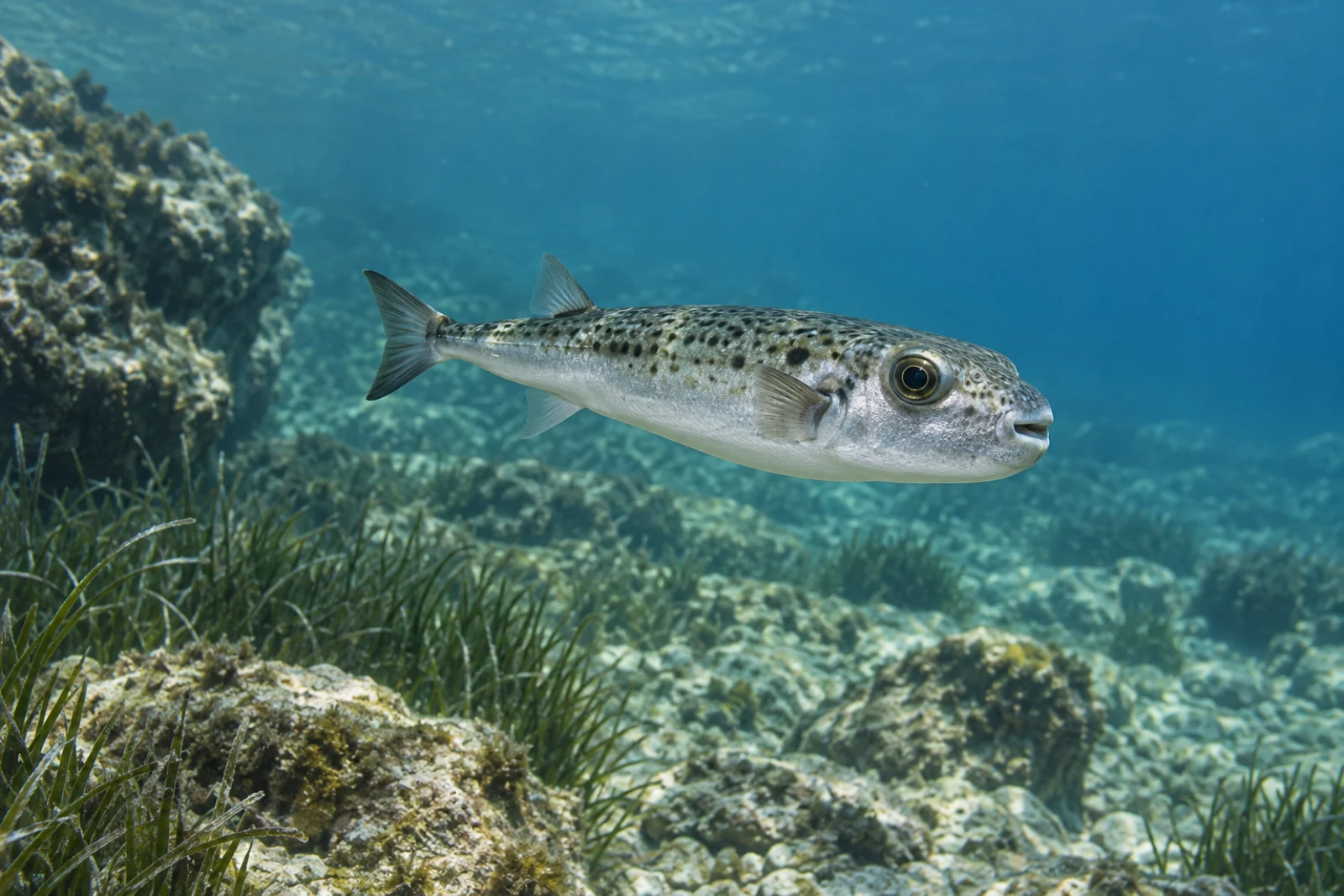
Media reports describe a silver-cheeked toadfish caught in the Kvarner. The species and its toxicity are established, but no publicly available confirmation from the Natural History Museum Rijeka has yet been found for this particular catch.
Two new risks that are not the same
Lionfish and silver-cheeked toadfish are often thrown together in a dramatic list of ‘poisonous fish’. That obscures the crucial difference. A lionfish carries venom in its spines; the primary danger is injury through contact or incorrect handling. With the silver-cheeked toadfish, the major risk is tetrodotoxin in its body and therefore consumption. Looking at either fish is very different from touching or eating it.
Ordinary swimmers have no reason to avoid the sea because of these species. Neither animal attacks humans as prey. The practical risk arises from curiosity, angling, collecting, spearfishing or experiments in the kitchen. The best everyday rule is unusually simple: keep your distance, take a photo, report the sighting – and keep both hands and plates empty.
The lionfish has arrived in the Adriatic
Between June 2024 and January 2025, the Institute of Oceanography and Fisheries evaluated 122 lionfish sightings along the eastern Adriatic. The species was also observed during winter and in shallow coves. This no longer suggests a few stray visitors, but rapid establishment in at least parts of the central and southern Adriatic.
Lionfish have long, conspicuous fin rays and venomous spines. Their ecological impact is at least as important as the medical risk: as successful predators, they can affect native fish communities while natural enemies are absent. Research and targeted removal by trained people are management matters – not an invitation for holidaymakers to hunt the fish themselves.
The toadfish is not an exotic dinner
Lagocephalus sceleratus, the silver-cheeked toadfish, can contain tetrodotoxin. This powerful neurotoxin can cause paralysis and even respiratory arrest. Ordinary cooking, frying or freezing does not reliably make it harmless. The fish therefore has no place in a private kitchen and must not be treated as a daring holiday experiment.
Anglers cannot always identify problematic catches with certainty. An unknown fish resembling a pufferfish should not be gutted, fed to animals or given away. A photo, catch location and time can help researchers; the local harbour authority, fisheries office or institute can advise on reporting. A social-media comment is not permission to eat it.
Under water: Observe without approaching
Divers and snorkellers should keep their distance, avoid blocking the animal and never try to take a close-up with an outstretched hand. A lionfish may appear calm and change position when it feels crowded. Gloves do not reliably prevent a sting and often encourage unnecessary contact.
Do not touch dead animals or those washed ashore either. Venomous spines and tissue do not lose their risk immediately simply because the animal is no longer moving. Keep children and dogs away. A useful observation photo needs only a side view, a size comparison taken from a safe distance and the location.

When landing a catch, tools protect trained hands only
Professional or experienced fishers need species-specific procedures, sturdy containers and clear disposal arrangements. For occasional anglers, the better decision is not to remove an unknown catch from the hook with bare hands. Warn everyone else on board so that nobody reaches for it out of curiosity.
Lionfish are in principle edible when experts safely remove the venomous spines and process the fish correctly. That information is not a recipe. There is a crucial difference between ‘edible’ and ‘safe for a layperson to prepare’. The silver-cheeked toadfish explicitly offers no such culinary shortcut.
After a sting: Leave the water and arrange help
After a puncture injury, first get safely out of the water, avoid further spines and alert other people. Severe pain, swelling, circulatory or breathing problems require medical assistance; call 112 in an emergency. Remove jewellery near the affected area early because it may swell.
Medical sources mention hot, but not scalding, water as a possible first-aid measure for certain fish stings. It does not replace an assessment and must not cause burns. Do not cut open or suck the wound, and do not use dubious home remedies. If possible, photograph the species from a safe distance.
After possible consumption, every minute counts
Tingling or numbness around the mouth and face, nausea, weakness, coordination problems or breathing difficulties after eating an unknown fish are an emergency. Tetrodotoxin can act rapidly. Call 112, keep food remnants and information about the catch, and do not wait for a spontaneous improvement.
Do not induce vomiting or ask another person to ‘try some for comparison’. The Croatian public-health institute recommends rapid professional assessment in cases of poisoning and having information about the substance or product ready. For a fish, the relevant details are a photo, suspected species, quantity, time and preparation method.
Citizen observations help – panic images do not
Sightings reported by the public have enabled researchers to describe the spread of lionfish. Good data require location, date, depth, a photo and honest acknowledgement of uncertainty. A blurred fish should not be declared a ‘deadly invasion’ merely to attract attention. False reports waste time and distort the picture.
The Adriatic is changing as a result of warming, shipping and biological migration. Some new species are harmless; others are ecologically or medically significant. The appropriate response is knowledge: learn to recognise them, do not touch them, support official research and act correctly after an injury.
Reports should distinguish between an observation and a catch. A diver states the depth, habitat and behaviour; an angler also specifies the fishing gear and whether the animal was released alive or secured correctly. Never put a dangerous species back into a shallow swimming area just to obtain a better photograph.
Restaurants and fishmongers are not identification centres for an unknown private catch. Reputable businesses source controlled products and work with expertise. Anyone offering a self-caught exotic fish transfers the risk to other people. When in doubt, keep the animal out of the food chain.
The message for families is deliberately sober: children may admire conspicuous fish, but they should not play with unknown animals in rock pools or buckets. Adults should not turn a sighting into a dare. Calm behaviour protects people, the animal and the quality of the observation at the same time.
Evidence
Sources & date
Sources support the facts. Planning notes and recommendations are Golden Beach editorial assessments.
- Spread of the invasive lionfish in the AdriaticInstitute of Oceanography and Fisheries Split · 6 June 2025, checked 18 August 2026122 sightings, establishment, ecological impact and spine risk
- New fish species in the AdriaticInstitute of Oceanography and Fisheries Split · 2026, checked 18 August 2026Expert assessment of lionfish and silver-cheeked toadfish
- Poisonings and envenomations during travelUS Centers for Disease Control and Prevention · Yellow Book, checked 18 August 2026Difference between venomous spines and toxic consumption, and the first-aid framework
- Tetrodotoxin emergency response cardCDC/NIOSH · ongoing, checked 18 August 2026Effects, symptoms and urgency of tetrodotoxin exposure
- Advice for chemical or natural poisoningCroatian Institute of Public Health HZJZ · ongoing, checked 18 August 2026General procedure and professional assistance when poisoning is suspected


