

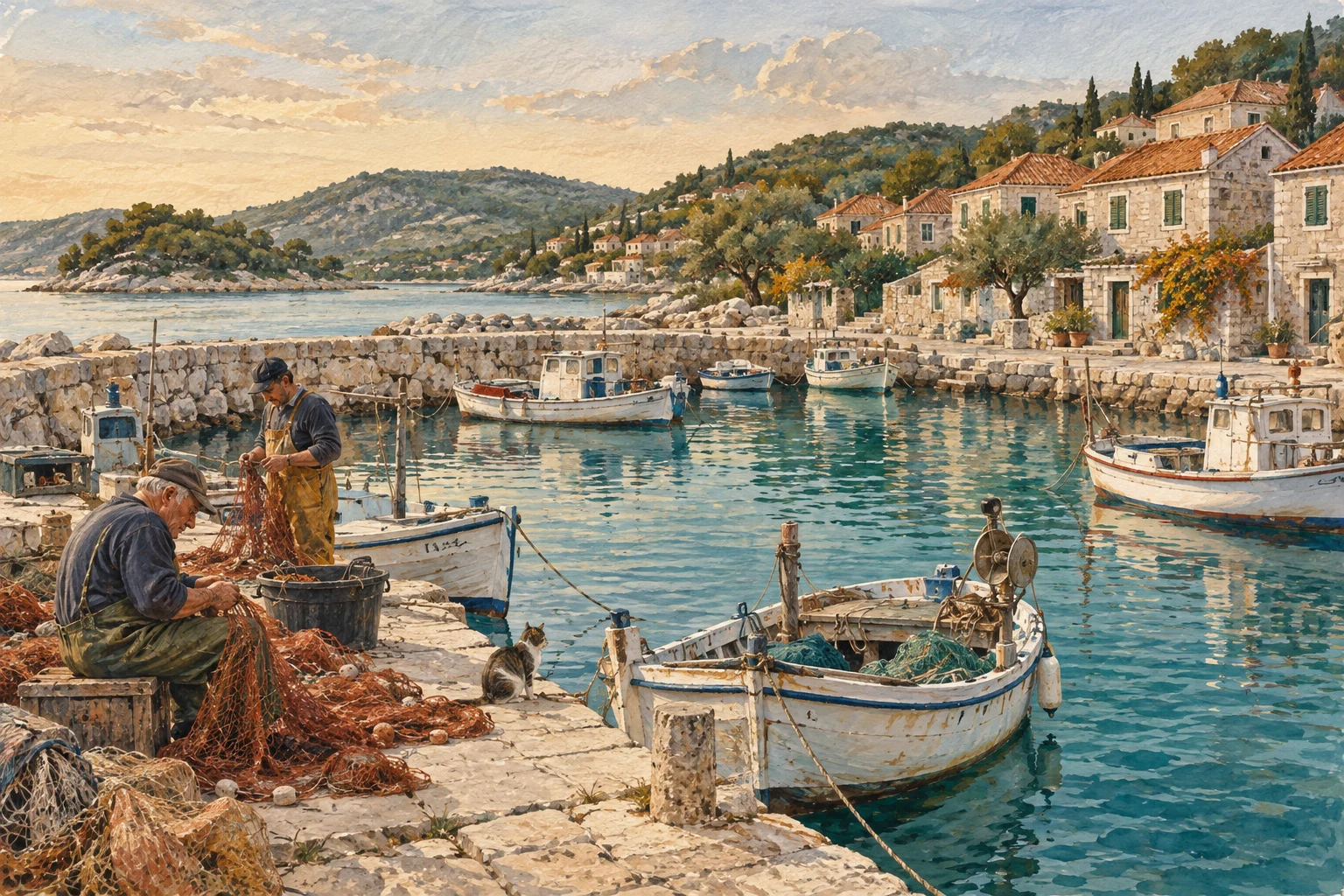
Fishing boats, narrow streets and a long connection with seafaring define Jezera. Looking only at the marina means missing the older village—and the surprisingly land-based explanation for its name.
A village that did not begin with yachts
Jezera lies in the southeast of the island of Murter, on a bay surrounded by hills. The local tourist board describes it as a village of fishermen, seafarers and divers. That context is more useful to visitors than the promise of a supposedly undiscovered hidden gem: harbour work and tourism share the same space here.
A walk can therefore begin by the water, but should not end there. The boats speak of everyday life today; the older settlement areas explain why the village was not always built so close to the shoreline. The real story of Jezera lies between the two.
Why the name sounds like lakes
The village's name is explained by accumulations of rainwater on ground with low permeability. It does not refer to a chain of large swimming lakes. The tourist board mentions, among other places, the former marshland of Blato and the seasonally water-filled depression of Lokva. Blato was drained in the early 20th century, partly in connection with the malaria problem at the time.
Another piece of local history fits this account: the chapel of Saint Konstancija on Kružak hill was built as a votive church in connection with illness and fever. Such links turn a name or a small church into a way of understanding life in the past—without implying any present-day health advice.
From the older village to the waterfront
The local historical account gives 1298 as the earliest written mention. It also describes older traces, so a first mention is not the same as a foundation date. The spatial development is particularly revealing: Selo and Košuluk were around 400 metres from the sea, while newer building along the waterfront began in the mid-18th century.
For your own walk, it is therefore worth moving between the waterfront and the narrow streets. The parish church of Gospa od Zdravlja is one of the important buildings; the local history dates the Baroque structure to 1722. Check locally whether a church or exhibition is currently accessible, rather than inferring fixed opening hours from a historical entry.
Getting there and going ashore remain practical matters
Murter is connected to the mainland via Tisno. Visitors arriving by car therefore do not need a ferry, though checking the current timetable for the movable bridge and possible waiting times is still worthwhile. We explain the existing winter timetable separately.
Boat crews have a dedicated point of contact at the ACI Marina. Berths, dimensions, costs and current conditions should be discussed with the operator. The sheltered shape of a bay is no substitute for checking the weather. And even with the finest photo opportunity at the fishing quay, nets, lines and working routes are not a visitor trail.
Evidence
Sources & date
Sources support the facts. Planning notes and recommendations are Golden Beach editorial assessments.
- About JezeraTuristička zajednica Jezera · Undated; checked 16 October 2026Location, maritime tradition and origin of the village's name
- History of JezeraTuristička zajednica Jezera · Undated; checked 16 October 2026First mention, older settlement areas and churches; conflicting renovation dates not reproduced
- ACI marina JezeraACI · Checked 16 October 2026Operator contact and nautical infrastructure, not a blanket safety guarantee


