


In the third quarter of 2025, Jadranska Hrvatska led EU regions for short-term rentals through major platforms. The figure provides substantiated context on seasonality—not a new visitor record from October 2026.
A summer figure that deserves an explanation
On 1 April 2026, Eurostat reported 27.7 million guest nights in short-stay accommodation booked through major online platforms in the statistical region of Jadranska Hrvatska. The period covered is July to September 2025. This put Croatia’s Adriatic region ahead of the other EU regions at NUTS-2 level that quarter.
The figure does not become new simply because it reappears in a feed in autumn. It is nevertheless a useful reason to examine seasonality more closely. Its value lies in a clearly defined summer comparison, not a supposedly current record report for the whole of 2026.
Guest nights are neither people nor bookings
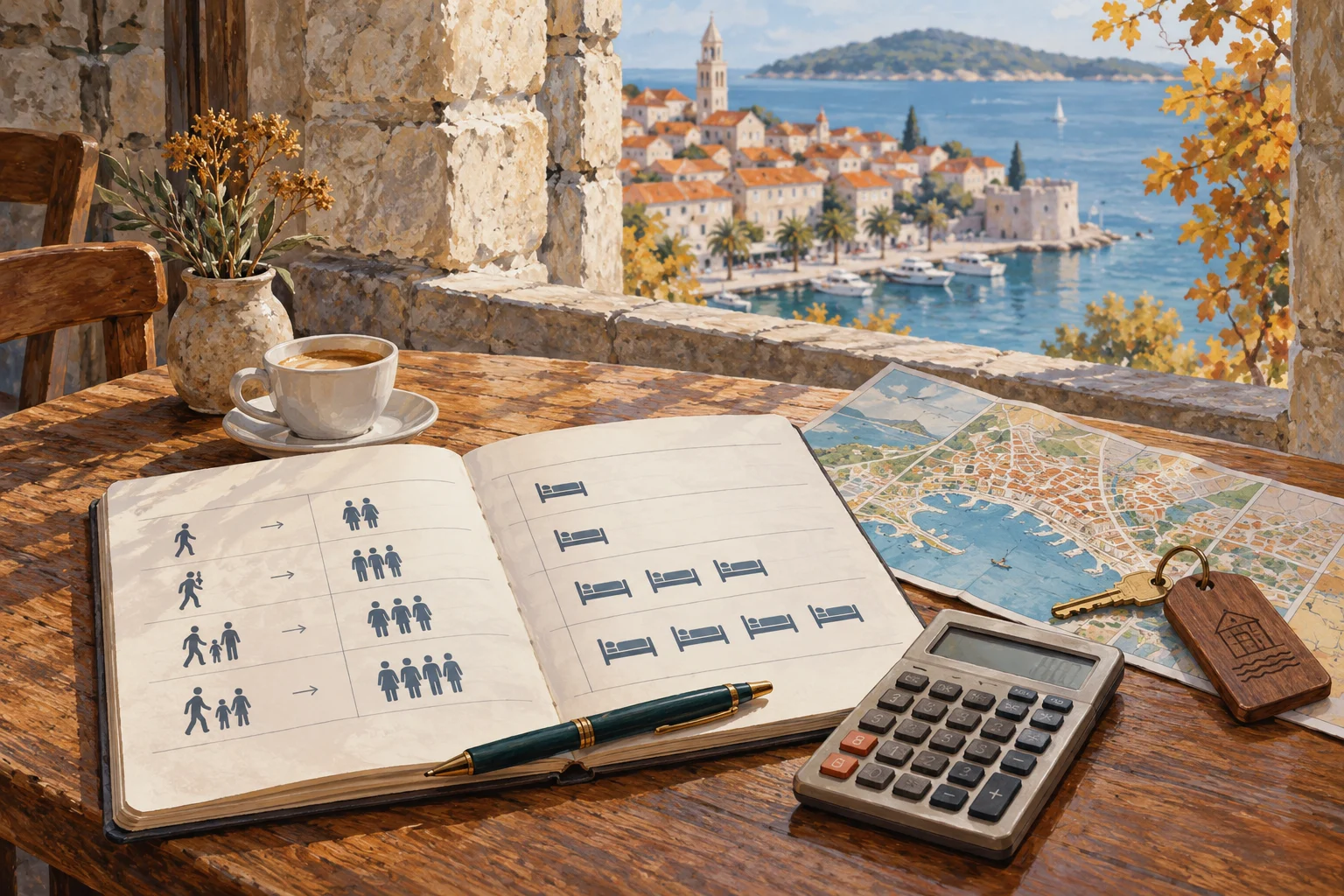
Three people spending four nights in an apartment generate twelve guest nights. They are still only three guests on one stay. This simple example shows why 27.7 million nights must not be turned into the same number of additional holidaymakers.
Nor can the number of properties be calculated from it. That would require knowing how many apartments and beds were offered and how long they were occupied. Discussions of overcrowding, vacancies or housing based on this figure need additional data. The large total describes usage, but not available supply on its own.
A fair comparison also requires the right geographical level. Jadranska Hrvatska is a statistical region, not a single city or coastal resort. Comparing a small municipality with this regional total would reveal more about their different geographical sizes than their actual pressures.
Not every Booking reservation belongs in this statistic
Here Eurostat examines short-stay accommodation such as apartments booked through Airbnb, Booking and Expedia. Hotels and campsites are excluded from this series. For reference year 2025, Tripadvisor is no longer part of the platform group, having left this business at the end of 2024.
A platform’s name is therefore not a sufficient definition. The fact that a hotel can also be booked there does not automatically put its overnight stays in this analysis. Conversely, stays booked directly with the host are absent from a platform-only view. This series is therefore not a complete account of Croatian tourism.
Caution is particularly useful when comparing it with eVisitor reports or municipal season summaries. A different statistical population can show different trends without either series being wrong. Only after checking accommodation types, period and area can we sensibly ask whether the figures tell the same story.
The more recent EU finding answers a different question
In its release of 2 October 2026, Eurostat gives a total of 258.8 million platform nights in the EU for April to June 2026, 5.3 percent more than a year earlier. The regional data published at the same time concern the first quarter of 2026. Canarias and Rhône-Alpes led those figures with 8.8 million nights each, followed by Andalucía.
This does not disprove the Croatian Adriatic region’s summer lead in the previous year. Winter, spring and high summer are different travel periods. Equally, the EU increase of 5.3 percent must not be presented as Croatia’s own growth without a Croatian national figure.
A current news item does not necessarily have to replace an older figure. Both can be useful side by side if labelled correctly: summer 2025 for regional seasonality; the second quarter of 2026 for the more recent trend in the EU-wide series. Missing information should remain clearly identified as missing.
What the finding contributes to the coastal debate
A high number of guest nights in one summer quarter highlights the importance of holiday apartments and platform-booked stays. Alone, however, it explains neither rents, water use, traffic nor individual hosts’ profitability. Each of those questions requires appropriate additional measures.
The useful next step is therefore not a blanket judgement for or against visitors. It is to examine places and periods: when is particular infrastructure used, what is available outside peak season, and how do individual municipalities differ? A leading regional figure can prompt these questions, but cannot pre-empt the answers.
For travellers, the statistic is above all an antidote to imprecise record-breaking headlines. It does not say which apartment is free next weekend. For the editorial team, it remains useful background: even an older figure, properly explained, can offer more guidance than a supposedly new sensation.
Evidence
Sources & date
Sources support the facts. Planning notes and recommendations are Golden Beach editorial assessments.
- Tourism nights booked via platforms hit nearly 1 billionEurostat · 1 April 2026Regional quarterly data for Q3 2025; not a current overall account of 2026
- Short-stay accommodation offered via online platforms (PDF)Eurostat / Statistics Explained · checked 25 October 2026Accommodation definition, guest nights and platform changes; data as of June 2026
- Tourism nights booked online up 5.3% in Q2 2026Eurostat · 2 October 2026More recent EU quarterly figure and regional winter comparison, not Croatia’s national growth rate


