

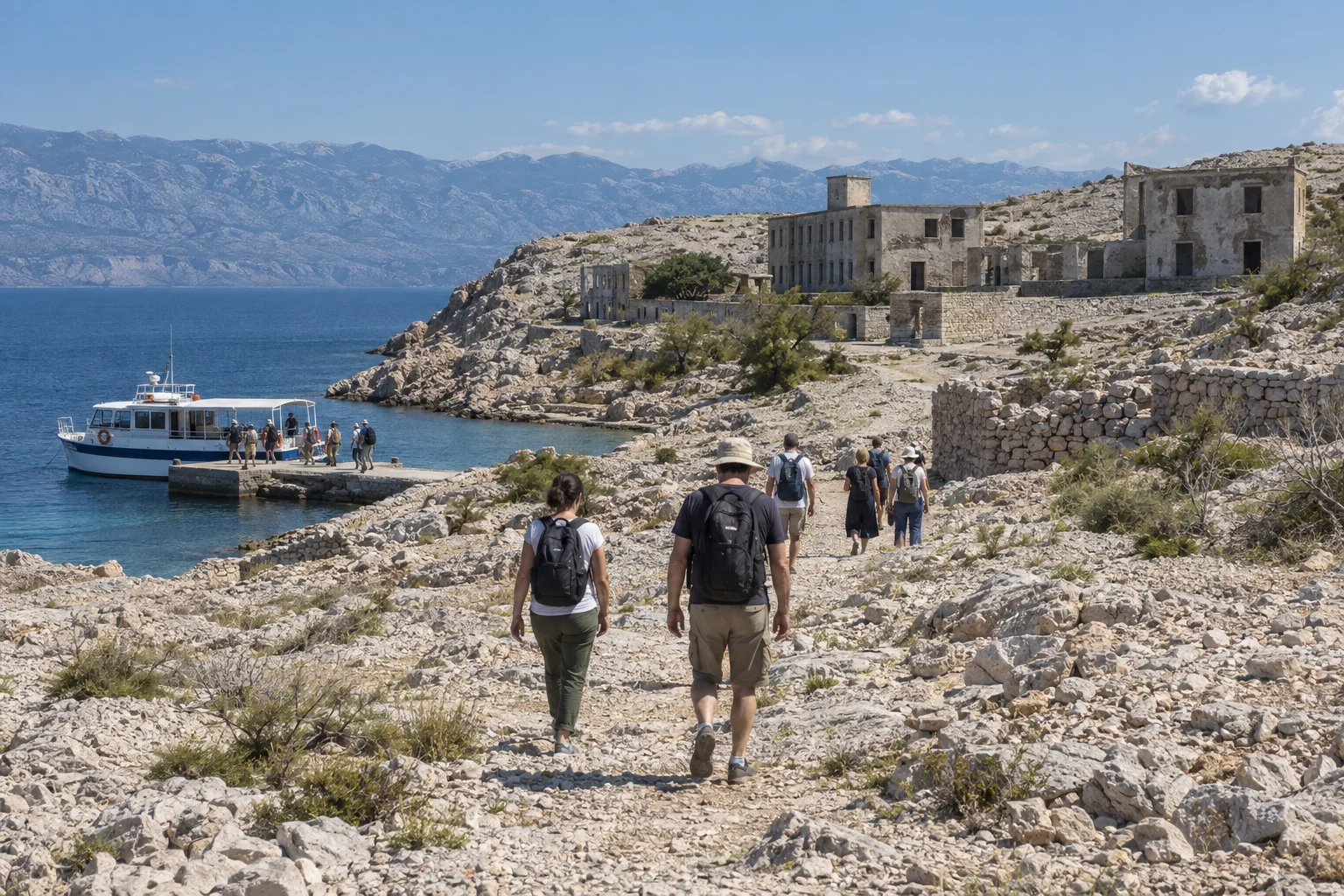
Excursion boats bring visitors to decaying buildings without a complete memorial site. Anyone going needs water, a secure return sailing—and a historical guide.
Goli otok is not an ordinary lost place
Goli otok can be visited by excursion boat. Yet among the landing, workshops, walls and overgrown paths, visitors stand at a place where people were imprisoned, watched, abused and forced to work.
Golden Beach’s existing article on Goli otok, Sveti Grgur and Kampor documents the official memorial route of August 2026. This article deliberately complements it by explaining the historical layers and how to prepare for an independent visit practically and respectfully.
A camp for political re-education began in 1949
After Tito’s break with Stalin and Yugoslavia’s expulsion from the Cominform, a camp was established in 1949 for real and alleged supporters of the Soviet Union. Some people arrived after court judgments, others through administrative decisions.
Forced labour, violence, mutual surveillance and abuse were part of the system. The virtual guide’s historical account gives about 13,000 prisoners and 287 documented deaths for 1949–1956. These figures apply to that defined political-camp phase.
The island remained a prison after 1956
The political internment camp closed at the end of 1956. Goli otok continued to operate as an ordinary prison and later also as a correctional institution. Operations ended only in 1988.
Not every building visible today therefore survives unchanged from the early camp years. Some belong to the later prison phase or were altered then. Without precise identification, a photograph of a ruin is not automatically evidence from 1949.
Women were imprisoned on Goli otok and Sveti Grgur too
The abbreviated image of an exclusively male camp is wrong. Women were held for a time in separate sections on Goli otok and on neighbouring Sveti Grgur.
Different publications give different totals for different periods and institutions. These must not be blended into a seemingly uniform balance. Every number needs its period, type of detention and location.
Travel is by excursion or private boat
The official 2026 line register lists no regular public passenger service to Goli otok. The Rab Tourist Board confirms organised excursions, and commercial tours are also offered from other places in Kvarner.
Departure point, price, guiding and time ashore vary by provider. Four questions matter before booking: how long is the landing, is historical guiding included, where does the boat berth, and what happens in the bora or unsafe seas?
The online guide and island circuit are two different levels
The free virtual guide by Documenta and the Friedrich Ebert Foundation contains eleven place chapters. Sveti Grgur is a separate memorial site on another island—not a stop on a walking route across Goli otok.
For Goli otok, the accompanying PDF outlines a roughly 60-minute circuit with eight stops. It does not replace expert guiding, but gives an independent landing a reliable structure. Download it before crossing, as stable data service and enough time are not guaranteed.
The ruins are not a fully secured exhibition
Goli otok has no continuously developed memorial with every building secured and a published hazard plan. Many structures have been damaged by decades of salt, wind and decay.
Sturdy footwear is therefore sensible. Roofs, unstable stairs and visibly collapse-prone rooms are not viewpoints. Children should not walk unsupervised among the ruins, and a commercial landing is no guarantee that every building may be entered.
Water, sun and the bora are not minor details
The barren limestone island has no natural drinking-water source. Shade is limited, the ground uneven and summer sun intense. Water, head protection and a small first-aid kit are therefore basic equipment.
The bora can alter the landing or return trip. What matters is not only the brochure time, but the operator’s current decision on weather, route and berthing.
Respect is visible in language and behaviour
Photography can document. Turning suffering into a backdrop for staged prison selfies, taking objects or writing on walls instead treats the site as an adventure playground.
Captions matter too: an unidentified workshop remains a workshop from an unknown phase, not a torture chamber without evidence. The tourist label Croatian Alcatraz reduces the history and is unsuitable as an editorial name.
A good visit does not end at the last ruin
Before departure, clarify the guide, weather, time ashore and return sailing. On the island, walk only as far as fitness, heat and departure time permit. A generous buffer at the boat matters more than the last photograph.
Anyone seeking deeper understanding should choose knowledgeable guiding and also read testimony and research. The boat trip will not become a complete historical reckoning—but it can be a visit that does not erase the people behind the ruins.
Evidence
Sources & date
Sources support the facts. Planning notes and recommendations are Golden Beach editorial assessments.
- Goli otokHrvatska enciklopedija · checked 26 September 2026Historical overview, political-camp phase, later prison use and closure
- Virtualni vodič po Golom otokuDocumenta / Friedrich Ebert Foundation · checked 26 September 2026Eleven stops, historical tour, source work and testimony
- Logor za politički preodgoj 1949.–1956.Documenta / Friedrich Ebert Foundation · checked 26 September 2026Origins, detention paths, camp system, about 13,000 prisoners and 287 documented deaths in the defined period
- Zašto njegujemo sjećanje na Goli otok?Documenta / Friedrich Ebert Foundation · checked 26 September 2026Remembrance culture and reasons for historical interpretation
- Goli Otok – virtual guide PDFDocumenta / Friedrich Ebert Foundation · checked 26 September 2026Route, stops, women’s camp, later uses and visit duration
- Goli otok excursionRab Tourist Board · checked 26 September 2026Confirmation of organised tourist excursions
- Linije 2026Coastal Liner Services Agency · 2026; checked 26 September 2026Check of the regular state network, with no public passenger line to Goli otok


