

The anchoring threads of a fan mussel became an unusual textile. Historical accounts lead to Dalmatia, a Croatian family estate to Vienna. What the sources tell us—and why the mussel must stay in the sea today.
A small cap opens up a big story
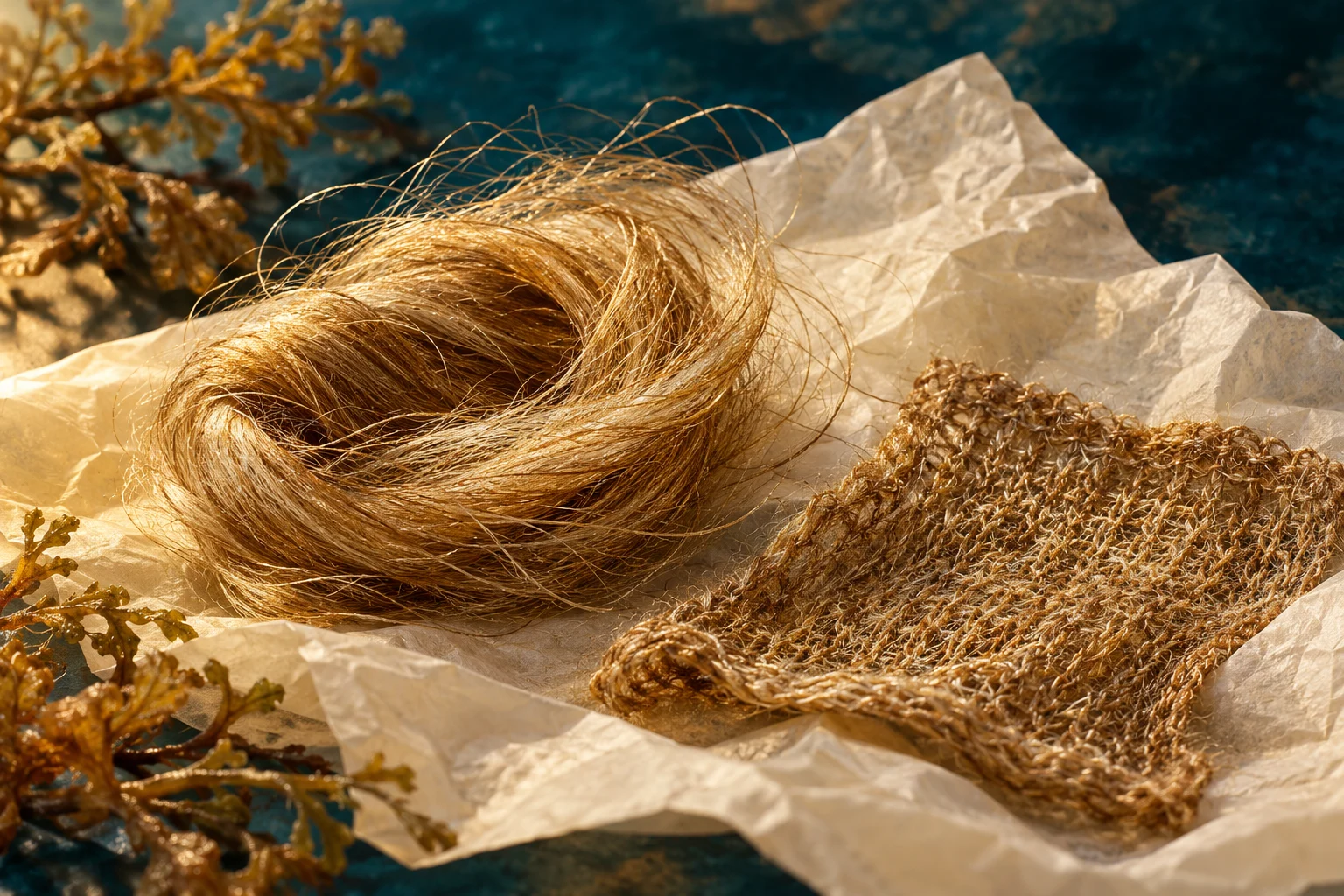
No treasure chest, no sunken ship: this trail begins with a family estate. In spring 2024, the Naturhistorisches Museum Wien reported that Ivica Basic had donated several bundles of fibres and a knitted sea-silk cap from his Croatian grandmother’s estate. The pieces were added to the mollusc collection.
This is a concrete connection between Croatia and a rare textile material. The museum note, however, gives neither the cap’s place of manufacture nor its age. Ownership by a Croatian family does not automatically prove manufacture in Dalmatia. Nor does accession to a collection mean that the piece is permanently on public display today. Anyone wishing to see it should ask the museum before travelling.
What connects the mussel to the thread?
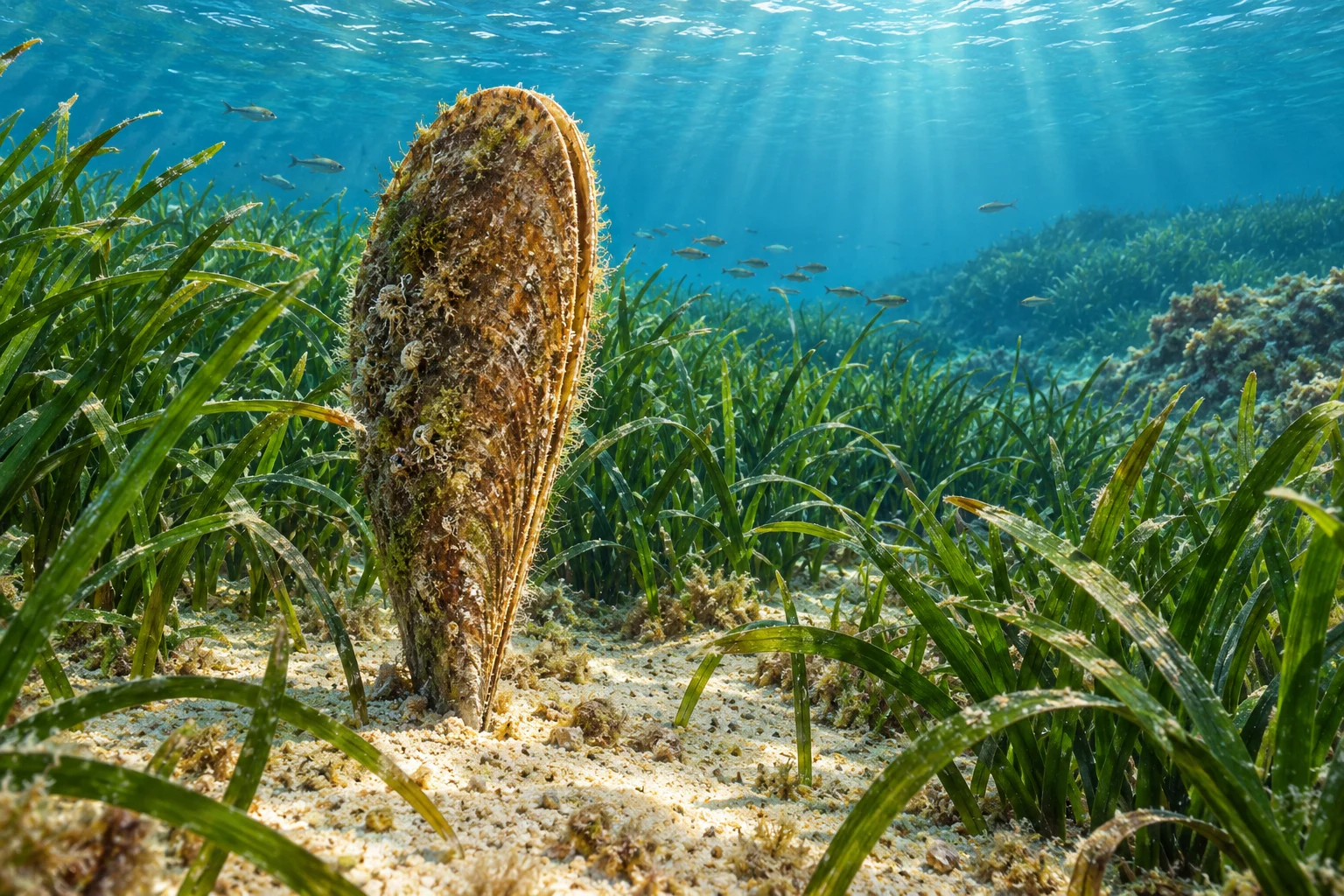
The fibres do not come from a cocoon. The noble pen shell produces fine anchoring threads that secure it to the seabed. The protein secretion it releases for this purpose solidifies in seawater. The cleaned and combed tuft of fibres, the byssus, yields the material known as sea silk.
The name draws attention to the textile; biologically, its original purpose is attachment. This shift of perspective is precisely what makes the story interesting: something that holds the animal in place became a material people worked. The illustrations shown here explain the material and habitat. They are not photographs of the Vienna donation.
Dalmatia is more than an attractive guess
The Muschelseide research project traces written evidence to the eastern Adriatic. In a 1771 guide to natural-history journeys along the Dalmatian coast, Alberto Fortis asked about harvesting the fibres and referred to Istria. The project overview also associates his later accounts with processing in Dalmatia.
For 1846, it documents a reference by Blumenbach stating that material previously sold to Naples was now being processed in Dalmatia itself. These are historical statements about a practice—not production statistics or a complete directory of its workshops.
The evidence supports telling a story of connections, but not an unbroken industrial history. Who worked where, how much was produced, and how were the finished pieces passed on? These sources leave such questions open. The Vienna donation adds to the Croatian trail; it does not retrospectively answer every question about the older travel accounts.
An old word can lead us astray
The Naturhistorisches Museum Basel has researched sea silk since 1998. According to its published overview, the project inventory comprises around 60 objects dating from the 14th to the mid-20th century. That is the scope of this inventory, not a claim that no further pieces could exist worldwide.
The history of the word is particularly revealing: in antiquity and until the Renaissance, byssus meant very fine linen. Only in the 16th century was the term transferred to the pen shell’s tuft of fibres. An old text containing the word byssus is therefore not, by itself, evidence of sea silk.
Interpreting a historical textile requires the terminology, material and provenance to fit together. An elaborate story about kings or ancient robes does not replace that assessment. Here the small, verifiable traces are more fascinating than a grand legend.
Today, the living mussel matters
Croatia’s environmental authority describes Pinna nobilis as a strictly protected, critically threatened species. A deadly infection has severely affected Mediterranean populations. Its guidance is clear: do not disturb the animals, and do not deliberately remove either living specimens or empty shells from the sea. Historical craftsmanship is not permission to collect.
A shell standing upright in the seabed does not prove that the mussel is still alive. Empty shells can remain upright for a long time and may be colonised by other animals. If you spot a possibly living pen shell while snorkelling, leave it untouched, document the observation with as little disturbance as possible and report the location to the responsible specialists. The ministry provides an online form and vrste@mzozt.hr for this purpose.
The story therefore does not lead to instructions for obtaining new fibres. Its value today lies in understanding existing textiles and their provenance—and preserving the habitat from which this unusual cultural heritage once came.
Evidence
Sources & date
Sources support the facts. Planning notes and recommendations are Golden Beach editorial assessments.
- Sea silk – research project and history of the termNaturhistorisches Museum Basel · checked 25 October 2026Definition, inventory and historical ambiguity of byssus; not a complete worldwide catalogue of objects
- Historical aspects: the modern era – Istria and DalmatiaProjekt Muschelseide / Felicitas Maeder · checked 25 October 2026Research overview citing Fortis 1771/1778 and Blumenbach 1846; original editions of the travel accounts were not directly consulted
- Silk from the sea – spun gold, pages 10–11Naturhistorisches Museum Wien / Anita Eschner; Archivkopie ZOBODAT · 15 March 2024; checked 25 October 2026Biology of the anchoring threads and 2024 donation from a Croatian family estate; no documented place of manufacture or current exhibition date
- Periske – jeste li ih vidjeli?Croatian Ministry of Environmental Protection and Green Transition · 22 July 2024; checked 25 October 2026Protection includes empty shells; limits of visual identification and reporting route; population figures from that time not reused as a current count


